

 Dennis Weaver
- Preheat the oven to the right temperature every time. Start heating the oven well ahead. It takes longer to heat than you think. That little indicator light that says the oven is now 350°F—it isn’t. That’s set on a timer, not a thermostat. The only way that you’ll know for sure is with an oven thermometer.
- Make sure your oven is 350°F for every batch. Trust your thermometer. Your oven is not set at a constant temperature. It cycles. When your oven cools, it turns on and starts to heat. And then it stops, and it starts to cool. Check your thermometer. You may need to wait a couple of minutes for the temperature to reach 350°F again.
- Line your pans with parchment paper. I use two large, 11x17-inch baking sheets. (But I don’t put both in the oven at the same time; it’s too hard to bake both sheets evenly.) I load the second pan while the first is baking.
- If you don’t have parchment paper, wipe the grease off your pan after each use. Extra melted butter or shortening in your pan will change how your cookies bake, how they spread, and how long they will need to bake. (Invest in parchment paper.)
- Make your cookies all the same size. Use an ice cream scoop (usually a one-ounce scoop). Scoop and press the dough against the side of the bowl to eliminate any voids. Load them onto the parchment paper with room to expand.
- Put the same number of cookies on the sheet every time. Twelve one-ounce cookies on a sheet is usually right. More cookies take longer to bake, and fewer cookies bake quicker. So, the same number of cookies is important. When you run out of cookie dough, and you only have eight or ten for the last batch, set the timer for less time, a minute or two less. You’ll have to guess. The cookies are done when the bottoms are golden, not brown. Take one of the cookies from the oven, put it on a cooling rack, and hold the rack up to see the color of the bottom.
- Bake them for the same time, every time. You’ll need a timer that counts seconds, not one that only reads minutes. (Most timers don’t use the timer on our microwave.) Fifteen seconds too long and your cookies are no longer perfect.
- Get them off the pan immediately. They will continue to bake on the hot sheet. The easiest, quickest way to get them off the sheet is to set a cooling rack next to the baking sheet, grab the edge of the parchment paper, and drag it off the pan onto the rack.

If you don't use a cookie scoop to measure your dough, you can't get your cookies the same size! If they aren't the same size, they won't bake evenly.
"After comparing other cookie scoops at different retailers in the area, this was by far the best made. All metal parts/no plastic. This medium size is perfect for the average size cookie. Only frustration is that I should have purchased it long ago."--Rachel
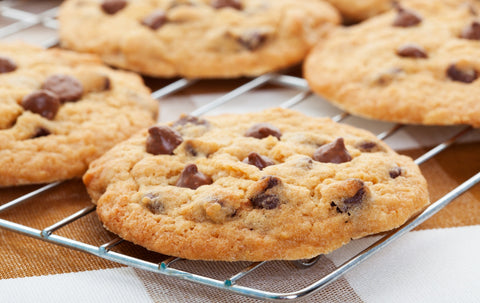
The most important key to making great cookies is not to over-bake them. They should be golden on the bottom, not brown, and an extra 15 seconds in the oven will make a difference. Use a timer with a second hand. (I use the timer on the microwave since it counts the seconds, and then I put an Everywhere Timer on a cord around my neck so I'm not bound to the kitchen. I set the timer for one minute less to give me time to get to the kitchen.
But different-sized cookies bake at different times. If your cookies are not all the same size, some will take longer than others.
You can make remarkably uniform cookies with a cookie scoop. They're round, they're the same size, and they all bake evenly.
Scoop the batter with the scoop. Then press and the scoop against the side of the bowl so the dough is compressed in the scoop and leveled off.

Comments (0)
There are no comments for this article. Be the first one to leave a message!